
The Thumb-Driven Dealership: How Mobile Matters In The Auto Buying Journey
Douglas Karr March 9, 2026
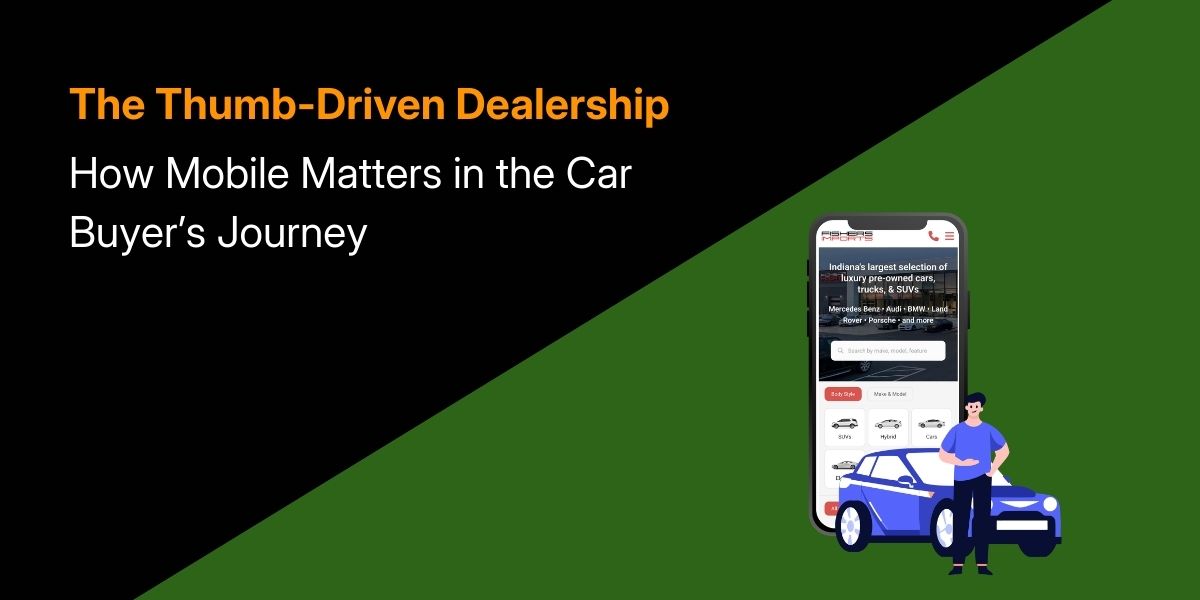
In 2026, the front door of an automotive dealership is not made of glass and steel; it is made of pixels. While the physical lot remains the place where the final handshake happens, the journey to that handshake is almost entirely digital and increasingly mobile-dependent.
For automotive professionals, understanding the friction between high mobile traffic and desktop conversion is no longer a technical detail. It is the primary lever for business growth.
The Mobile Traffic Paradox
The data is clear: mobile-first browsing has officially become the industry standard. Historical benchmarks placed mobile at 61% of traffic, but data from dealer networks shows that mobile traffic has surged to 71% for many providers.
However, a curious gap persists at the local level. Individual dealership-specific sites often see mobile traffic hovering between 40% and 50%, as documented in studies of dealership habits. This discrepancy suggests a Research vs. Intent divide.
Research-Driven
- “Best family SUVs with third-row seating 2026”
- “Electric vs hybrid pros and cons for long commutes”
- “Safest luxury sedans under $50,000”
- “Toyota RAV4 vs Honda CR-V fuel efficiency comparison”
- “What is the average maintenance cost for a turbocharged engine”
- “Top rated pickup trucks for towing a boat”
Intent-Driven
- “Ford F-150 Lightning for sale in Greenwood IN”
- “Used Honda Civic deals near me”
- “Schedule a test drive for 2026 BMW X5”
- “Lease specials for Nissan Rogue at [Local Dealer Name]”
- “Trade-in value for 2021 Jeep Wrangler”
- “Auto financing for 650 credit score Indiana”
While shoppers use broad aggregators to browse casually on their phones, they often switch to desktops when they land on a specific dealer’s site to perform the heavy lifting. This includes comparing VIN-specific features, calculating complex financing, or reviewing protection plans.
The 70% Rule: Mobile as the Constant Companion
Regardless of where the final click happens, the influence of the smartphone is absolute. According to research, over 70% of automotive shoppers now use a mobile device at some point during their car-buying journey.
Mobile has also become an indispensable in-store tool. In fact, over 80% of shoppers use digital tools, often via mobile, while physically standing on a dealership lot to verify pricing against competitors or research vehicle history.
The Conversion Gap: 1.7x Desktop Dominance
Despite the volume of mobile users, the Desktop Advantage remains the industry’s biggest hurdle. Demand Local benchmarks confirm that desktop still converts at a rate 1.7x higher than mobile.
| Metric | Mobile | Desktop |
| Traffic Share (Avg) | 61% – 71% | 29% – 39% |
| Conversion Factor | 1.0x | 1.7x |
| Primary Use Case | Discovery & Local Search | Financing & Final Lead Form |
The complexity of an automotive purchase is the primary culprit. The cognitive load of navigating a 15-field finance application on a 6-inch screen is high. When a mobile experience is clunky, users do not just wait; they bounce.
The Make-or-Break Factors: Speed, Usability, and Continuity
If mobile traffic is the engine of your digital strategy, these three pillars are the fuel. In the high-stakes automotive market, patience is a luxury dealerships cannot afford to test.
1. The Cost of a Second (Speed)
Modern shoppers expect a site to load in under 2.5 seconds. Research confirms that for every additional second of load time, conversion rates can drop significantly; in fact, sites that load in 1 second have conversion rates 5x higher than those that take 10 seconds. In an industry where a single lead can represent a $40,000 sale, a slow-loading inventory page is a massive financial leak.
Shift Digital’s Digital Automotive Shopping Pulse Report revealed a brutal truth: if your site fails Google’s Core Web Vitals, you’re throwing away $30 of every $100 in ad spend.
2. Frictionless Design (Usability)
Usability on mobile is not about shrinking a desktop site; it is about thumb-friendly navigation.
- The Fat-Finger Test: Buttons must be large enough to tap without zooming.
- Verticality: Mobile users prefer vertical scrolling over horizontal carousels.
- Smart Forms: Autofill-enabled fields and Click-to-Call buttons are mandatory. Approximately 60% of mobile searchers prefer calling a dealership directly.
3. Seamless Cross-Device Experience (Continuity)
Because the car-buying journey often starts on a phone and concludes on a desktop, the hand-off must be invisible. Continuity ensures that a shopper who saves a vehicle or starts a trade-in appraisal on their mobile device finds that exact progress waiting for them on their computer.
When a site fails to sync these experiences, the user is forced to repeat their work. True excellence means providing a persistent, unified experience that follows the user across every screen they own.
Bridging the Device Divide
Mobile matters because it is the bridge of the omnichannel experience. By 2026, the goal is not to force a mobile user to complete a 30-minute application on their phone. Instead, it is to provide a lightning-fast, intuitive interface that captures the lead instantly.
The dealers who will dominate the next decade are those who recognize that while the desktop often closes the deal, the mobile phone—and the speed at which it operates—is what starts the relationship.
The Overfuel Advantage: Dominating the Digital Drive
While many providers struggle to balance aesthetic design with technical performance, Overfuel dominates through relentless optimization of speed, usability, and continuity. We recognize that the 1.7x desktop conversion gap is not a constant; it is a symptom of poor mobile design and poor continuity between devices.
By delivering a truly seamless experience between mobile and desktop environments, Overfuel ensures that the transition from a casual near me search to a formal finance application is frictionless. Our platform’s lightning-fast load times and thumb-optimized interfaces are the primary reasons we lead the market in search visibility, user engagement, and total conversions. When the site works better, the site is found more, buyers engage deeper, and dealerships sell more.
